

My teeth are sensitive to hot and cold. I told my dentist this, and she recommended I use a desensitizing toothpaste. But are they safe? How does desensitizing toothpaste work?
Desensitizing toothpaste is safe, but I think you have great instincts to think that any chemical that might numb the sensation in your mouth could potentially be harmful.
Here’s how desensitizing toothpaste works: it contains ingredients such as potassium nitrate or strontium chloride, which block pain signals to the nerve of the tooth by stopping up the tiny tunnels in your teeth, which go to the nerve.
What Causes Tooth Sensitivity?
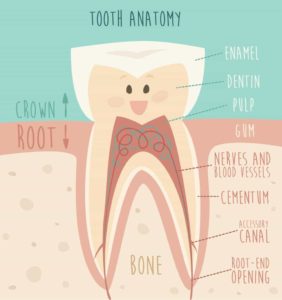 Normally, your teeth are protected from sensitivity thanks to enamel, which is the white part of the tooth.
See the picture on the right? The white enamel is protecting the inner yellow dentin.
When enamel is worn away, the inner parts of the tooth are exposed to air and what you eat, and this is what makes your teeth sensitive.
What makes us lose protective enamel? Enamel is worn down every day with grinding and acids in the foods and drinks we consume.
Not flossing also makes teeth sensitive because it causes your gums to pull away from the teeth, exposing the inner dentin that would normally be protected by your gums.
Get Dr. B’s Dental Health Tips
You can’t be healthy without a healthy mouth. Sign up for my free newsletter and you’ll get my unconventional tips, starting with: If I had a cavity, here’s exactly what I’d do to reverse it.

Is the Active Ingredient in Desensitizing Toothpaste Safe?
One of the best resources for checking if an ingredient is safe or not is the Environmental Working Group (EWG), which keeps a database on the safety of thousands of commonly used chemicals based on published scientific literature.
 Potassium nitrate got the best score from the EWG: 1 on a scale from zero to 10, with 10 being the highest hazard and 0-2 being “low hazard.”
Stannous fluoride got the second best score: 2 out of 10. While fluoride is not effective in strengthening teeth in the form of toothpaste, it is a very effective desensitizer.
 Strontium chloride scored 3 out of 10 – “moderate hazard.” It’s been banned by the Japanese government for being unsafe for use in cosmetics.
Potassium nitrate will work just as well as strontium chloride in terms of reducing your sensitivity, so my recommendation is this – just go with the safer active ingredient: potassium nitrate.
If you suffer from severe sensitivity, stannous fluoride is your best bet for getting relief. There’s a toothpaste that’s much better than over-the-counter desensitizing toothpaste — it’s called Colgate Prevident 5000 and requires a prescription from your dentist. Unfortunately, it contains SLS (sodium lauryl sulfate), but if you’re in need of the strongest possible desensitizer to get out of pain, this is the most effective.
How Desensitizing Toothpaste Works
1. Some brands claim their toothpaste can reduce sensitivity within two uses. I’d say it’s closer to about a month of consistent daily use.
2. It only treats symptoms after the fact — it can’t cure your sensitivity. What does that mean? Imagine if your house was on fire and you responded by trying to remove the smoke. If your teeth are sensitive, something bad is happening to cause those symptoms. Desensitizing toothpaste is great for feeling better, and I use it myself, but make sure to treat the root cause of your sensitivity to protect your teeth from getting worse. or at least know root cause because it could be masking symptoms of something bigger later on.
Mark Burhenne DDS
Got more questions about teeth sensitivity? Ask me a question!
The Complete Guide to DIY Toothpaste (And The Recipe I Use)
 6 Reasons to Scrape Your Tongue