

Last week’s list landed harder than I expected — especially the dark
chocolate thing! (Here it is in case you missed it.)
So let’s keep going…
Your dentist has told you plenty of things avoid: sugar, soda, ice, sticky candy.
But they’ve probably never told you what to eat. (That is, if you’re not seeing a Functional Dentist.)
Here are six more foods that your teeth (and oral microbiome) love…
7. Green tea
One cup, mid-morning, after my coffee. That’s been the routine for years.
The EGCG in green tea (a polyphenol you’ve probably heard about for its antioxidant effects) does something specific in your mouth. It interferes with the glucosyltransferase enzymes (GTF) that Streptococcus mutans, the bacterium most responsible for cavities, uses to build the sticky biofilm that anchors it to your enamel. No biofilm, no foothold.
A 2021 study found EGCG inhibits S. mutans biofilm formation in a dose-dependent way – meaning the more consistently you drink green tea, the more consistently you’re disrupting the early steps of cavity formation.
One caveat worth knowing: cheap tea is a documented source of heavy metals – lead, arsenic, cadmium, depending on where it was grown. I only drink tea that’s been third-party tested for contamination. This is what I drink every day.
8. Pastured eggs
Two soft-boiled, most mornings. Not for the protein, but for what’s in the yolk!
The yolks of eggs from pastured hens (chickens that actually see sunlight and eat insects) carry vitamin D3 and vitamin K2 – two fat-soluble vitamins that work together in a way most people don’t realize. D3 helps your body absorb calcium. K2 directs that calcium into your
teeth and bones, where you want it, not your arteries, where you don’t.
Most people who supplement D3 take it without K2. The result: blood calcium goes up, but the calcium ends up in soft tissue instead of mineralizing your enamel and bone. The combination is what matters. Pastured eggs give you both, in a ratio your body can actually use.
Confined-cage supermarket eggs have a fraction of the D3 and K2. If you can find pastured eggs at a farmer’s market, I feel they’re worth the upgrade.
9. Arugula, spinach, and beets
Here’s something your cardiologist and your dentist should both be telling you, and probably aren’t.
The nitrates concentrated in dark leafy greens (and in beets) get converted by specific bacteria living on your tongue into nitric oxide – the molecule that relaxes blood vessels, supports healthy blood pressure, and keeps the tissue around your teeth supplied with the blood flow it needs to repair itself.
When you use antiseptic mouthwash, you kill the bacteria responsible for that conversion. A 2017 study tracked 945 adults over three years and found twice-daily mouthwash users had a 55% higher risk of developing pre-diabetes or diabetes, likely because their oral bacteria couldn’t make enough nitric oxide to keep their metabolism running properly.
Eat the arugula. Put down the Listerine. And pop one of these mints!
10. Sardines
A 4-oz tin of wild sardines packed in olive oil gives you more vitamin D3 than five eggs and the long-chain omega-3 fatty acids (EPA and DHA) that quietly do the work of lowering the systemic inflammation that drives gum disease, cardiovascular disease, and arthritis.
I prefer sardines to bigger fish for a simple reason: they’re at the bottom of the food chain. Less time eating other fish means less mercury and heavy metals accumulating in their tissue. Look for wild-caught (Wild Planet and Bela are two reliable brands), packed in
olive oil, with the bones and skin intact.
11. Shiitake mushrooms
Compounds in shiitake get in the way of how Streptococcus mutans – the bacterium most responsible for cavities – sticks to your teeth in the first place. Specifically, they interfere with glucosyltransferases (GTF), the enzymes S. mutans uses to spin sugar into the sticky glucans that let it anchor to enamel and build a dense, acid-retaining biofilm.
In plain English: shiitake doesn’t kill the bacteria. It takes away their grip. Without that sticky scaffold, S. mutans has a much harder time hanging on, multiplying, and producing the acid that eats through enamel.
This is what we call modulation – changing how a bug behaves instead of trying to wipe it out.
Modulation of the bugs is a more nuanced way of seeing the oral microbiome, and honestly where the science is heading. Shiitake targets a virulence mechanism that’s far more pronounced in S. mutans than in the commensals, so the biofilm shifts away from a cavity-promoting state instead of getting bulldozed the way chlorhexidine bulldozes everything. Shiitake also delivers B vitamins, which your gum tissue uses for repair.
12. Leeks
Leeks are in the allium family – same as onions, garlic, and shallots – but they bring something the others bring less of: a high concentration of prebiotic fibers called fructans which feed the healthy bacteria.
The commensal species in your mouth – the ones that produce nitric oxide, support remineralization, and crowd out cavity-causing pathogens – ferment these fibers and multiply. S. mutans, on the other hand, prefers simple sugars and can’t make much use of
ructans. So when you eat leeks regularly, you’re tilting the balance toward the species you want and starving the ones you don’t.
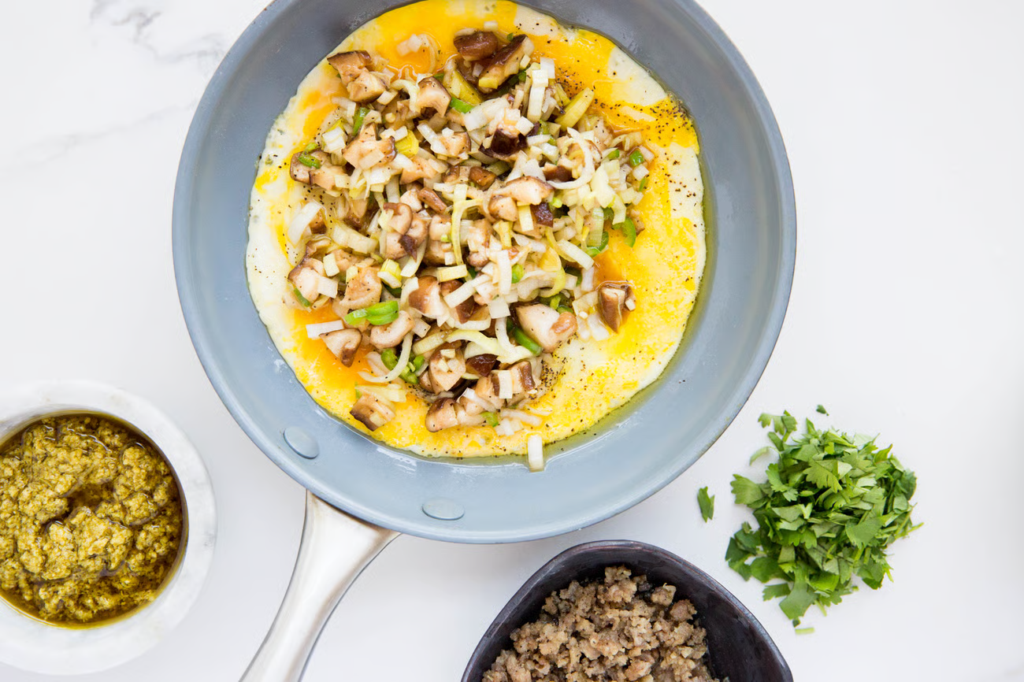
I sauté them with shiitake and serrano peppers and fold them into my Oral Microbiome Omelet most weekend mornings. If you want a single breakfast that pulls three of these foods together – pastured eggs, shiitake, and leeks – you’ll want to check out this recipe.
Eat well. And remember – last week’s rule still applies: wait 30 to 45 minutes after eating before brushing. For those of you dashing out the door every morning, brush before breakfast, not after!
–Dr. B

Further Reading on AsktheDentist.com:
Why Your Cardiologist Should Talk to Your Dentist: the deep dive on the gum-disease and heart-health link behind why greens and beets matter.
I add this to my water every morning: the case for mineral-rich hydration and what it does for your saliva.
What I wish more people knew about green tea + your teeth: my deep dive on why green tea should have a spot in your oral care routine.
Top Vitamin K2 Foods: why K2 directs calcium into your teeth and bones instead of your
arteries
Citations:
EGCG and S. mutans biofilm inhibition
Zayed SM, Aboulwafa MM, Hashem AM, Saleh SE. “Biofilm formation by Streptococcus mutans and its inhibition by green tea extracts.” AMB Express. 2021;11:73.https://pmc.ncbi.nlm.nih.gov/articles/PMC8149520/
Mouthwash, nitric oxide, and prediabetes risk
-Joshipura KJ, Muñoz-Torres FJ, Morou-Bermudez E, Patel RP. “Over-the-counter mouthwash use and risk of pre-diabetes/diabetes.” Nitric Oxide. 2017;71:14-20.
https://pubmed.ncbi.nlm.nih.gov/28939409/
Shiitake antigingivitis selectivity
Ciric L, Tymon A, Zaura E, et al. “In vitro assessment of shiitake mushroom (Lentinula edodes) extract for its antigingivitis activity.” Journal of Biomedicine and Biotechnology. 2011;2011:507908.
https://pubmed.ncbi.nlm.nih.gov/21966183/

 After every cleaning, I sent my patients home with chocolate